El Chupacabra is an undiscovered blood-drinking predator
By Colin PetersonJuly 8, 2026
Where the evidence lands: Contradicted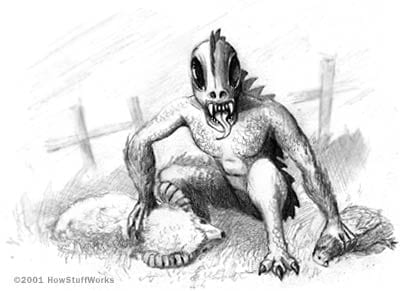
That an undiscovered predator (originally described as a spined, bipedal, alien-like creature and later as a hairless, canine-like animal) stalks Puerto Rico, Mexico, and the southwestern United States, killing livestock and pets by draining their blood.
Contradicted. The 1995 description traces to a witness who had seen the alien in the film Species; the later hairless “carcasses” have been DNA-tested as coyotes and dogs with severe mange, and the “drained” livestock were never actually exsanguinated.
Believed by: A recognisable folk figure across Puerto Rico, Mexico, and the US Southwest
The full story
A creature with two faces
The chupacabra is unusual among cryptids because it has never settled on a single description. The 1995 original, reported across Puerto Rico, was an alien-like biped: grey-skinned, roughly four feet tall, walking upright on two legs, with a row of spines or quills down its back and large, wraparound black eyes. That is the creature witnesses drew, and the one that gave the animal its name after a wave of livestock (mostly goats) turned up dead and, reportedly, drained of blood.
By the 2000s, in Texas and the US Southwest, a second and quite different chupacabra had taken over the popular imagination: a hairless, dog-like quadruped with grey-blue, wrinkled skin, a pronounced overbite, and a bony ridge along its spine. This is the version most often represented by an actual recovered carcass, and it is the version that has been tested in a laboratory. The two descriptions barely resemble one another, which is itself a clue: this is not one animal being observed twice, but two different cultural moments generating two different monsters under the same inherited name.
What the believers saw
Take the strongest version of the case, because parts of it are not in dispute. Livestock in Puerto Rico really did die in unusual numbers starting in early 1995: goats and sheep found in fields with wounds to the neck or chest, discovered by farmers who had not seen anything like it before. Whatever killed those animals was real, and the fear it produced across rural Puerto Rico that year was genuine, not manufactured.
The reports that followed were also strikingly consistent for a period of months. Multiple witnesses independently described a similar creature: hunched, reptilian-grey, with spines down its back and unnaturally large eyes. When the same unfamiliar description turns up again and again from people who, as far as they knew, had not spoken to one another, that consistency is worth taking seriously rather than waving away.
Nor was 1995 the first time Puerto Rico had seen this exact pattern. In February 1975, an almost identical panic swept the town of Moca: fifteen cows, three goats, two geese, and a pig were found dead within days, marked by small puncture wounds and, according to contemporary reports, completely drained of blood. The killings spread into the spring (eight more goats and a dozen rabbits turned up dead in nearby Corozal by early April) before tapering off that summer, and Puerto Rico's Senate Agricultural Commission pushed police to keep investigating rather than settle for that explanation. There was no chupacabra folklore yet for anyone to reach for, and no film called Species to shape what a witness expected to see. Whatever the full explanation, this was not one Hollywood-primed account in an isolated year: it was the second time in twenty years that Puerto Rican farmers described the same specific, unsettling pattern of loss.
The scale mattered too. This was not one strange night: Puerto Rico logged more than two hundred reported livestock incidents before 1995 was out, spreading from a single farm into a territory-wide phenomenon in a matter of months. A local pattern that large, spreading that fast, is not nothing; something was moving through the countryside killing animals, and it is reasonable to want a single, coherent explanation for all of it rather than a patchwork of ordinary causes.
And a decade later, the story gained something no cryptid usually gets: an actual physical body. Ranchers in Texas (in Elmendorf in 2004, Cuero in 2007, Hood County in 2010) recovered dead animals that were, by any normal standard, bizarre: hairless, blue-grey, thick-skinned, with an odd-shaped skull and a jaw full of oversized teeth. These were not blurry photographs or a stranger's story. They were physical carcasses that experienced ranchers and even wildlife officials initially struggled to identify on sight: in the Elmendorf case, staff at a local zoo examined the skull and floated a Mexican hairless dog before anyone had run a single genetic test, which shows the animal was genuinely anomalous enough to stump people who identify wildlife for a living.
One of those Texas ranchers had a longer history with the animal than a single carcass suggests. Phylis Canion, the Cuero rancher whose freezer held the head that made headlines in 2007, believed something had already been killing her chickens for roughly two years beforehand, by her count around twenty-six of them, each left drained rather than carried off or eaten the way a normal predator's kill would be. That summer she saw the animal itself cross her pasture in daylight, and within days she and her neighbors had recovered three dead specimens near her property. Sending one for genetic testing wasn't a publicity stunt; it was, for a woman who had been losing livestock for two years, a chance to finally get an answer.
What the physical evidence actually shows
The Moca killings of 1975 don't rescue the theory, either. Police at the time attributed them to feral dogs (the same explanation offered for the 1995 wave two decades later) and while Puerto Rico's Senate Agricultural Commission publicly pushed for a fuller investigation, no forensic necropsy study comparable to the one later conducted on the 1990s cases was ever carried out on the Moca animals. What survives from 1975 is a body count, a rejected official explanation, and a nickname, not a documented cause. That a near-identical panic, and a near-identical rejection of the mundane explanation on offer, recurred twice twenty years apart says something about how reliably this kind of legend re-forms around ordinary livestock predation. It does not supply evidence of an actual creature in either decade.
Start with where the 1995 description came from. Researcher Benjamin Radford, in a five-year investigation published as Tracking the Chupacabra (University of New Mexico Press, 2011), traced the single most influential early sighting (Madelyne Tolentino's, in Canóvanas) directly to a movie. The science-fiction film Species, featuring a hunched, grey-skinned, spine-backed alien named Sil, opened in Puerto Rico on 7 July 1995, weeks before Tolentino's sighting became public. Radford confirmed she had seen the film, and her description of the chupacabra matches the creature's design (created by artist H.R. Giger) in striking detail: the posture, the spinal ridge, the oversized eyes. The founding description of the modern chupacabra did not emerge from an unknown animal. It emerged from a movie theater. The description didn't stay fixed once it existed, either: in a 2025 follow-up, Radford compared Tolentino's 1996 and 2010 interviews and found her account of the spines shift from rising and moving “rapidly from side to side” to flat and immobile, and the eyes drift from black to dark gray to red across retellings. It was an early version of that description, rendered as a composite sketch Tolentino produced with a local UFO researcher, that spread through Puerto Rican media and became the template for every alien-biped chupacabra reported afterward.
The blood-draining claim fares no better under direct examination. A Puerto Rican veterinarian with the island's Department of Agriculture, Dr. David Morales, personally necropsied roughly 300 animals reported as chupacabra victims. He found blood inside every one of them. What he documented instead was consistent with ordinary predation (dogs, and in some cases other conventional predators) plus the normal postmortem process by which blood settles and coagulates in the lower part of a carcass shortly after death, leaving the exposed upper surface looking pale and “drained” even though the blood never left the body. No forensic examination of an alleged chupacabra victim has ever documented true exsanguination.
The Texas carcasses are the most testable claim in the whole legend, because unlike a description, DNA does not depend on anyone's memory. Each recovered specimen was sent to a university genetics laboratory, and each came back the same way. The 2004 “Elmendorf Beast” was identified by the University of California, Davis Veterinary Genetics Laboratory as a coyote. The 2007 Cuero specimen was tested independently at Texas State University–San Marcos, where biologist Mike Forstner reported its DNA sequence as a near-identical match to coyote, with a separate analysis finding coyote ancestry on the maternal side and wolf on the paternal side. The 2010 Hood County animal was identified by Texas A&M University as a coyote-dog hybrid. None returned a result outside of known North American canid species.
Phylis Canion's own case shows how little the lab result changed anyone's mind. Her frozen specimen's DNA came back a coyote on the maternal side and, in a separate analysis, a Mexican wolf on the paternal side, a wild canid hybrid, not an undiscovered species, its appearance explained by the same mange documented in the Elmendorf and Hood County animals. Canion herself did not accept the identification. “I think it could have wolf in it,” she said afterward. “It has to be a cross between two or three different things.” Two years of real losses had told her that something unusual was killing her chickens; only the laboratory result could say what it actually was.
What explains the bizarre appearance is a genuine, well-documented veterinary condition: sarcoptic mange, caused by the burrowing mite Sarcoptes scabiei. A 2017 Texas A&M AgriLife Extension publication co-authored by wildlife specialist John Tomeček, Regents Professor Scott Henke, and veterinarian Terry Hensley lays out the mechanism directly: the mites trigger alopecia and intense scratching, producing near-total hair loss, thickened and grey, scale-like skin, and a ridge of surviving guard hairs along the animal's spine, the exact “ridge” reported by witnesses. A parallel, peer-reviewed veterinary review of sarcoptic mange in North American wildlife documents the same progression: alopecia, hyperkeratosis, emaciation, and, in advanced cases, complete denuding down to leathery, wrinkled skin. The same Texas A&M publication notes that mange-debilitated coyotes, unable to catch normal wary prey, are pushed toward easier targets, which is consistently where livestock losses blamed on the chupacabra are reported: animals confined in pens or corrals, not free-ranging wildlife.
The disease also has a documented progression that maps neatly onto why some mangy animals look far more monstrous than others. Wildlife veterinarians classify sarcoptic mange in stages, from patchy early hair loss to a severe final stage in which an animal is almost completely denuded, its skin grey, cracked, and hyperkeratotic across its whole body. A coyote is not born looking like a chupacabra; it is pushed there over weeks by an immune system losing a battle against thousands of burrowing mites, which is also why the animal grows gaunt, listless, and bold enough to wander into a rancher's yard in daylight: sick, starving, and running out of options, not stalking prey with any special cunning.
A name looking for a sighting
The chupacabra endures because it solves two separate, ordinary problems with one extraordinary word. A rancher who finds a dead goat with unexplained wounds, or spots a gaunt, hairless animal slinking along a fence line at dusk, is confronted with something genuinely startling, and “chupacabra” is a satisfying, specific answer, in a way that “probably a sick coyote” is not. Once the name existed, it gave shape to encounters that would otherwise have stayed formless and forgettable.
Timing mattered too. The chupacabra took off in the mid-1990s, at the height of a UFO and alien-abduction boom across Latin American and US popular culture. A movie-designed alien with a distinctive silhouette dropped into exactly the cultural moment primed to receive it, and the story had a decade's head start before anyone traced its origin back to a movie ticket.
The legend then did what folklore does: it travelled, and it adapted. As it moved from Puerto Rico into Mexico and the US Southwest, the description drifted from Tolentino's alien biped toward the hairless quadruped that matched the actual mangy coyotes ranchers were finding on the ground, the story reshaping itself around the physical evidence people kept stumbling into, rather than the other way around. And every widely reported recovered carcass renewed a news cycle that rarely circled back to report the DNA results with the same enthusiasm as the initial, stranger headline.
Mangy coyotes, not a monster
On the core claim (an undiscovered, blood-drinking predator) the rating is Contradicted. The original 1995 description traces to a specific film a key witness had recently watched; forensic necropsies of alleged victims have found blood, not an absence of it; and every physical specimen recovered and DNA-tested has come back as a known North American canid, most often a coyote, with its appearance explained by a well-understood parasitic skin disease.
What is not in dispute is that real animals died, real carcasses were recovered, and real people saw something that frightened them. The chupacabra is best understood not as a hoax invented from nothing, but as a case study in how an unfamiliar, genuinely disturbing sight (a mange-ravaged coyote, a predator's kill) gets sorted into a ready-made monster once one exists to receive it. Follow the physical evidence all the way through, and the goat-sucker resolves into something stranger in its own way: not a hidden species, but a visible illness, hiding in plain sight under an old story's name.
Watch
What's still unexplained
- The founding incident in each of the chupacabra's two major outbreaks was never individually, forensically confirmed the way the wider pattern later was. Puerto Rican police blamed feral dogs for the 1975 Moca killings, and the eight sheep found dead in Orocovis in March 1995 were reported drained of blood months before any organized necropsy program existed to check that claim, unlike the roughly 300 later 1995–96 cases a Department of Agriculture veterinarian did examine, in which blood was always still present. Ordinary predation, exaggerated by fear and after-the-fact storytelling, is almost certainly the explanation for both founding incidents too (it is the confirmed explanation for every later case that was actually examined) but neither original incident left behind the forensic paper trail that resolved the wider wave, so their specific causes are inferred by analogy rather than independently confirmed.
Point by point
The claim: The very first chupacabra description in 1995 was detailed and consistent; witnesses could not have invented the same unfamiliar creature independently.
What the record shows: The description is detailed, but it is not independent. The key early witness, Madelyne Tolentino, described a grey, hunched, bipedal creature with a spined back and enormous black eyes, a close match to the alien “Sil” in the film Species, which opened in Puerto Rico weeks before her sighting. Investigator Benjamin Radford confirmed she had seen the film beforehand.
The claim: Real dead livestock were found with puncture wounds and no blood, which ordinary predators do not do.
What the record shows: Dead livestock were real. But a Puerto Rico Department of Agriculture veterinarian who necropsied roughly 300 reported chupacabra victims found blood still present internally in every case, consistent with normal predation and postmortem blood pooling, not exsanguination by an unknown creature.
The claim: Actual chupacabra carcasses (hairless, grey-skinned, with a ridged back) have been physically recovered, not just described secondhand.
What the record shows: Carcasses have been recovered, and DNA testing has been performed on several of them by university laboratories. Every one identified came back as a known North American canid (coyote, domestic dog, or a coyote hybrid) with the hairless, scaly, ridge-backed appearance explained by advanced sarcoptic or demodectic mange.
Timeline
- Mar 1995Eight sheep are found dead on a farm in Orocovis, Puerto Rico, each with what were reported as puncture wounds and no visible blood, the first killings later attributed to the chupacabra.
- Aug 1995In Canóvanas, Puerto Rico, resident Madelyne Tolentino reports seeing the creature directly: a grey, spined, bipedal being with large dark eyes. Her description becomes the template for the modern chupacabra.
- 1995–1996The story spreads rapidly across Puerto Rico, then Mexico and the rest of Latin America, with hundreds of livestock deaths attributed to the creature.
- 2004–2010A series of hairless, dog-like carcasses are recovered in Texas (Elmendorf, Cuero, Hood County) and popularly dubbed “chupacabras.” Each is DNA-tested at a university laboratory.
- 2011Investigator Benjamin Radford publishes Tracking the Chupacabra, tracing Tolentino's original description to a specific film she had recently seen.
Contradicted. The 1995 description traces to a witness who had seen the alien in the film Species; the later hairless “carcasses” have been DNA-tested as coyotes and dogs with severe mange, and the “drained” livestock were never actually exsanguinated.
Reviewed by Colin Peterson · Last reviewed July 9, 2026 · How we rate
Common questions
Is El Chupacabra true?
Contradicted. The 1995 description traces to a witness who had seen the alien in the film Species; the later hairless “carcasses” have been DNA-tested as coyotes and dogs with severe mange, and the “drained” livestock were never actually exsanguinated.
What is El Chupacabra?
A creature blamed for draining the blood of goats and other livestock, first reported in Puerto Rico in 1995 and later reimagined in Texas as a hairless, dog-like animal, with an origin story, and a physical explanation, that both trace cleanly back to real, documented sources.
What does the evidence show?
The description is detailed, but it is not independent. The key early witness, Madelyne Tolentino, described a grey, hunched, bipedal creature with a spined back and enormous black eyes, a close match to the alien “Sil” in the film Species, which opened in Puerto Rico weeks before her sighting. Investigator Benjamin Radford confirmed she…
Why do people believe it?
The name itself supplies a ready explanation for a genuinely common and unpleasant sight: farmers who find a mange-ravaged coyote skulking near their livestock, or a dead animal with wounds they cannot immediately explain, already have a word for it.
What is still unresolved?
The founding incident in each of the chupacabra's two major outbreaks was never individually, forensically confirmed the way the wider pattern later was. Puerto Rican police blamed feral dogs for the 1975 Moca killings, and the eight sheep found dead in Orocovis in March 1995 were reported drained of blood months before any organized nec…
Sources
- 1.¡El Chupacabra! The Science Behind a Latin American Mystery (EWF-099), John M. Tomeček, Scott Henke & Terry Hensley, DVM, Texas A&M AgriLife Extension (2017)
- 2.A review of sarcoptic mange in North American wildlife, Niedringhaus, Brown, Sweeley & Yabsley, International Journal for Parasitology: Parasites and Wildlife (2019)
- 3.Tracking the Chupacabra: The Vampire Beast in Fact, Fiction, and Folklore, Benjamin Radford, University of New Mexico Press (2011)
- 4.Mythical, bloodsucking beast just a coyote (Cuero, TX DNA results), Associated Press / NBC News, citing Texas State University–San Marcos biologist Mike Forstner (2007)
- 5.Elmendorf Beast DNA identification, University of California, Davis Veterinary Genetics Laboratory (2004)
- 6.From spooky lore to science fact: Unmasking the “chupacabra”, Texas A&M AgriLife Today (2024)
- 7.1975, February–July: The Vampire of Moca, Anomalies: The Strange & Unexplained (anomalyinfo.com)
- 8.Texan claims she's found the mythical chupacabra, The Spokesman-Review (2007)
- 9.Chupacabra Revisited: Dueling Origin Stories of the Hispanic Vampire, Benjamin Radford, Skeptical Inquirer (2025)
Embed this verdict on your site
Paste this snippet to show our sourced verdict as a small card, with a link back to the full case file. Free to use.
<iframe src="https://theconspiratory.com/embed/chupacabra" title="The Conspiratory verdict" width="520" height="190" style="border:0;max-width:100%" loading="lazy"></iframe>Help us investigate
This is a living case file. If you spot an error or know evidence we missed, tell us, and weigh in on where you land.
Where do you land?
Cast your read on this one.
Comments
Add your take. Comments are read and approved by a human before they appear, so keep it on topic and civil. Please do not accuse named, living people of crimes.